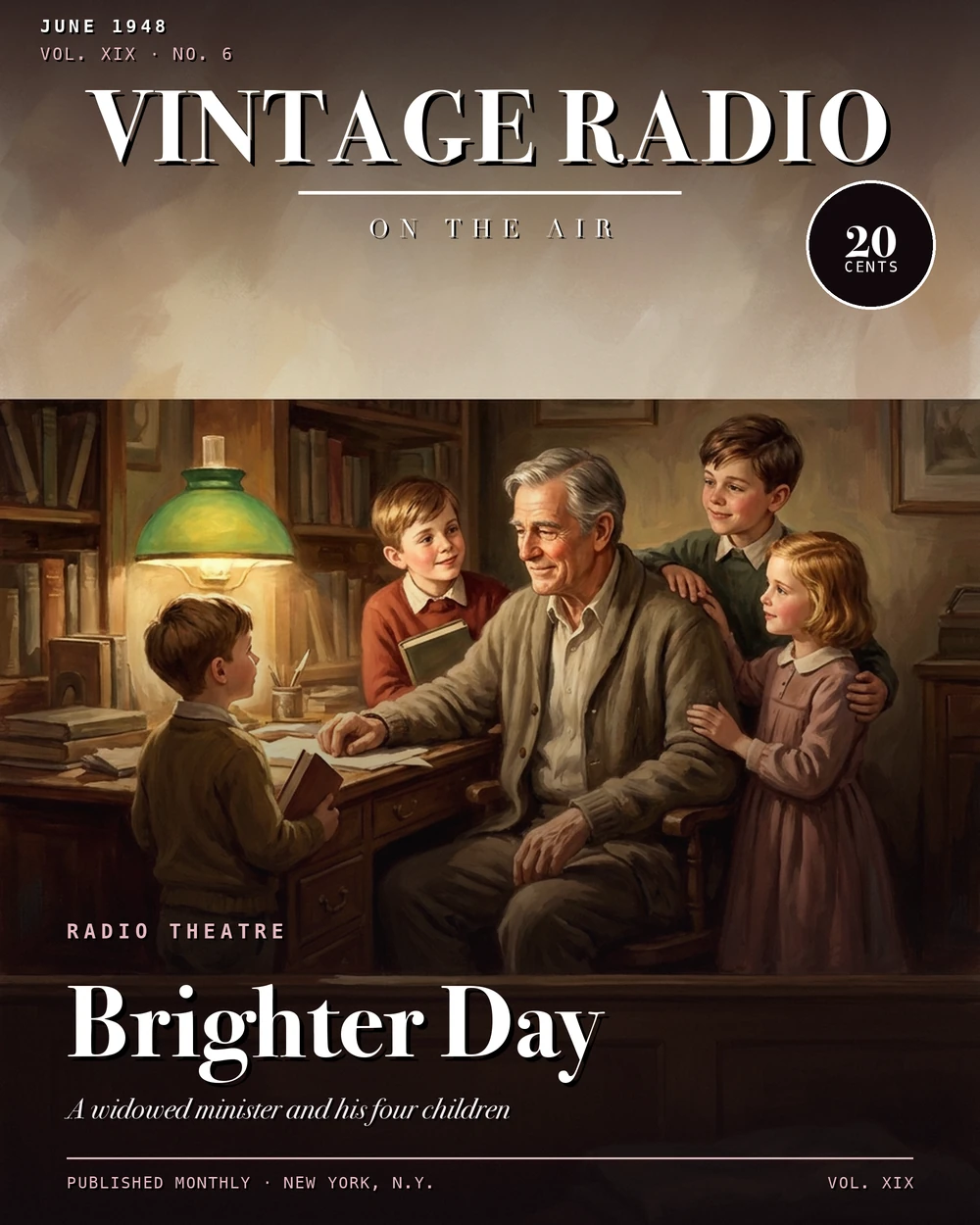
Brighter Day
How It Came to Be
Brighter Day didn't arrive out of nowhere — it grew out of another show. Joyce Jordan, M.D. had been running on NBC when creator Irna Phillips began introducing a new family into its storylines in the fall of 1948. A character named Liz Dennis started appearing in Joyce Jordan's world, and by early October she had essentially taken the show over, with Joyce reduced to the role of host. Joyce Jordan aired its final episode on October 8, 1948, and three days later Brighter Day launched in its place with the Dennis family front and center. As radio historian Jim Cox noted in The Great Radio Soap Operas (McFarland, 1999), fans were already well acquainted with the Dennises by the time the transition happened — which made for an unusually smooth handoff. The announcer, the sponsor (Dreft), the network, and the timeslot all stayed exactly as they were.
The show opened each episode with an epigraph that set its tone plainly: "Our years are as the falling leaves — we live, we love, we dream, and then we go. But somehow we keep hoping, don't we, that our dreams come true on that brighter day." That kind of opening signature was characteristic of Irna Phillips's work; she used it on several of her properties. The theme music was "At Dawning" by Charles Wakefield Cadman.
The Dennis Family
The show centered on Reverend Richard Dennis, a pastor in the town of Three Rivers who was raising four daughters and a son largely on his own. Bill Smith played the Reverend, a man trying to be both mother and father to Elizabeth, Althea, Barbara, and Patsy, plus Grayling, who was in his twenties and worked at the local newspaper.
In practice, the eldest daughter Liz — played first by Margaret Draper and later by Grace Matthews — took on much of the maternal weight in daily family life and gradually became the show's dominant character. John Raby played Dr. Jerry Forrester, her love interest. Althea, described as beautiful and self-centered, consumed by dreams of a theatrical career, was played at various points by Joan Alexander and Jay Meredith. The teenage Barbara, known throughout the run as "Babby," was played by Loma Lynn, Judith Lockser, and Mary Linn Beller across the show's eight years. Pat Hosley and Lois Nettleton both played the youngest daughter Patsy. Grayling cycled through three actors over the radio run — Billy Redfield, Bob Pollock, and Hal Holbrook — and Ann Hillary played his love interest Sandra Talbot.
That many of these roles were recast multiple times was typical of long-running radio serials, but the sheer number of actors who passed through Brighter Day is notable. Irna Phillips and her writing team — Orin Tovrov, Doris Frankel, and John Haggart — kept the storylines running continuously while the cast shifted around them. Producers David Lesan, Beverly Smith, and Bob Steel oversaw the production, with directors Ted Corday, Mary Harris, Edwin Wolfe, and Art Hanna rotating through the chair.
The Network Years
Brighter Day ran on NBC from its premiere on October 11, 1948, through July 8, 1949 — about nine months — airing weekdays at 10:45 in a 15-minute format. It then moved to CBS three days later, premiering there on July 11, 1949, and stayed for the rest of its radio run. On CBS it aired at 2:45 weekdays, same 15-minute format, with the timeslot shifting to 2:15 in the final year, 1955–56. Dreft was the sponsor on both networks.
The radio serial ended on June 29, 1956 — but by then the show had already been living a double life for more than two years.
When Radio and Television Ran Together
On January 4, 1954, CBS launched a television version of Brighter Day, and for two and a half years both the radio and television versions ran simultaneously. That overlap period is unusual enough to be worth noting: the same story world, the same characters, airing on two different media at once, with the writing team threading continuity across both.
The transition had been prepared carefully. In late 1953, a flood storyline washed out the town of Three Rivers on radio, forcing the Dennis family to relocate to a place called New Hope — which is where the television version began. The TV series was set in New Hope, Wisconsin (some sources say New Hope, Pennsylvania). On television, Liz had married and left the household before the series began, which reduced the core family to Reverend Dennis and four children: Althea, Patsy, Babby, and Grayling.
Blair Davies played Reverend Dennis on the television version; William Smith briefly held the role in 1954 during the transition period. Also living in the household was the Reverend's widowed sister, Emily Potter, played by Mona Bruns. A running gag among the cast held that Aunt Emily was constantly shown entering or exiting to the kitchen — even though no kitchen set was ever built for the show.
Hal Holbrook carried Grayling from radio into television and appeared in roughly 287 episodes between 1954 and 1959. He had landed the radio job in 1954 — the same year he gave his first solo Mark Twain performance at Lock Haven State Teachers College — and while doing the daytime soap, he kept developing his Mark Twain stage show at a Greenwich Village nightclub after each day's taping. Lois Nettleton, born in Oak Park, Illinois in 1927, originated the role of Patsy Dennis on the television version before going on to a career that included three Primetime Emmy nominations and two Daytime Emmy wins. Mary Linn Beller continued as Babby on television; Brook Byron played Althea in the early television run, with Jayne Heller later taking over the role of Althea Dennis Bigby.
Patty Duke appeared in 1958–59 playing Ellen Williams Dennis — before her Academy Award–winning performance as Helen Keller in The Miracle Worker (1962), for which she won Best Supporting Actress at the 35th Academy Awards, becoming one of the youngest recipients in that category. Douglas Marland, born Marland Messner, also appeared on the show early in his career before eventually becoming a prominent soap opera writer. Bernie Kopell appeared alongside a young Harvey Korman, according to Kopell's Television Academy oral history; Nancy Malone worked with actor Joe Sirola on the serial, per the same Television Academy records.
The television series was notable as the first soap opera on network television with an explicitly religious theme. Irna Phillips's earlier serial The Guiding Light had carried a religious theme on radio but dropped it before moving to television; Brighter Day kept it.
How It Ended
The television version's ratings were solid through most of the 1950s — typically placing fifth to seventh overall in the CBS daytime lineup, with its best season coming in 1955–56, when ABC had no strong competing offerings. The premiere of American Bandstand in 1957 and its surge in popularity the following year cost Brighter Day and several adjacent CBS soaps roughly a Nielsen rating point each. The Secret Storm and The Edge of Night eventually recovered their numbers; Brighter Day did not.
In the summer of 1961, Procter & Gamble handed production of the television show back to CBS and moved it from New York to Los Angeles to cut costs. Key characters and storylines were dropped because some actors wouldn't relocate. Then in the summer of 1962, CBS expanded The Secret Storm into an hour-long block to compete with American Bandstand, which forced Brighter Day and The Verdict Is Yours out of their afternoon slots and into morning timeslots. The move cut Brighter Day's Nielsen rating nearly in half — from 6.9 to 3.7 — and the show was cancelled shortly thereafter.
The series ended on September 28, 1962, with less than two weeks' notice from the network. Toward the end of the run, Agnes Nixon had been hired to write for the show; she later wrote The Guiding Light and Another World, and went on to create All My Children and One Life to Live for ABC. She reportedly developed a character whose DNA can be traced to Ada and Rachel Davis of Another World — but the show was cancelled before that work was ever taped.
The cancellation had one further footnote. In August 1962, Brighter Day had announced the first daytime television contract role for an African American actor: Rex Ingram, a Northwestern University graduate and stage and film veteran whose prior credits included The Green Pastures (1936) and The Thief of Bagdad (1940), was hired to play Reverend Victor Graham, an ordained minister. He first appeared on September 17, 1962 — eleven days before the show went off the air. His contract role lasted two episodes.
The television version ran approximately 1,830 episodes over eight and a half years. Irna Phillips shaped Brighter Day across its entire life on both radio and television, making it one of the longest-running single properties she ever produced — and one whose handoff from Joyce Jordan, M.D. through the 1953 flood storyline to a New Hope television parsonage is a small clinic in how a serial writer thought across media.